You can find the source code at https://github.com/nano-o/streamlet.
Context and results
The Streamlet blockchain-consensus algorithm is arguably one of the simplest blockchain-consensus algorithm. What makes Streamlet simple is that there are only two types of messages (leader proposals and votes) and processes repeat the same, simple propose-vote pattern ad infinitum. In contrast, protocols like Paxos or PBFT alternate between two sub-protocols: one for the normal case, when things go well, and a view-change sub-protocol to recover from failures.
The proofs in the Streamlet paper use the operational reasoning style, where we consider an entire execution and try to reason about the possible ordering of events in order to show by case analysis that the algorithm is correct. In my experience, this proof style is very error-prone, and it is not easy to make sure that no case was overlooked. I would prefer a proof based on inductive invariants, but that’s a discussion that’s off-topic for this post.
Instead, in this post, we will specify the Streamlet algorithm in PlusCal/TLA+ and use the TLC model-checker to verify its safety and liveness properties in small but non-trivial configurations. Moreover, the specification I present are also an example of:
- how to use non-determinism to obtain simple specifications
- how to exploit the commutativity of actions to speed-up model-checking by sequentializing the specification.
I was able to exhaustively check the safety and liveness properties of (crash-stop) Streamlet in interesting configurations:
- with 3 processes, 2 block payloads, and 7 asynchronous epochs;
- with 3 processes, 2 block payloads, and 5 asynchronous epochs followed by 4 synchronous epochs (i.e. “GST” happens at the start of epoch 6).
Those results give me very high confidence that streamlet satisfies its claimed properties.
We’ll also see that TLC verifies that, in all configurations checked, Streamlet guarantees that a new block gets finalized in 4 synchronous rounds. This is better than the bound of 5 rounds proved in the Streamlet paper, and I believe that a bound of 4 holds in general.
The Streamlet algorithm
The goal of the Streamlet algorithm is to enable a fixed set of N processes in a message-passing network to iteratively construct a unique and ever-growing blockchain.
Although many such algorithms existed before Streamlet, Streamlet is striking because of the simplicity of the rules that processes must follow.
Streamlet can tolerate malicious, Byzantine processes, but, to simplify things, here we consider only crash-stop faults and we assume that, in every execution, a strict majority of the processes do not fail. As is customary, we refer to a strict majority as a quorum.
The protocol evolves in consecutive epochs numbered 1,2,3,… during which processes vote for blocks according to the rules below.
A block consists of a hash of a previous block, an epoch number, and a payload (e.g. a set of transactions); moreover, a special, unique genesis block has epoch number 0.
Thus a set of blocks forms a directed graph such that (b1,b2) is an edge if and only if b2 contains the hash of block b1.
We say that a set of blocks forms a valid block tree when the directed graph formed by the blocks is a
tree rooted at the genesis block. A valid blockchain (or simply a chain for short) is a valid block tree in which every block has at most one successor, i.e. in which there are no forks.
Each epoch e has a unique, pre-determined leader (e.g. process (e mod N)+1), and processes in epoch e must follow the following rules:
- The leader proposes a new block with epoch number
ethat extends one of the longest notarized chains that the leader knows of (where notarized is defined below). - Every process votes for the leader’s proposal as long as the proposal is longer than the longest notarized chains that the process ever voted to extend.1
- A block is notarized when it has gathered votes from a quorum in the same epoch, and a chain is notarized when all its blocks, except the genesis block, are notarized.
- When a notarized chain includes three adjacent blocks with consecutive epoch numbers, the prefix of the chain up to the second of those 3 blocks is considered final.
Process proceed from one epoch to the next through unspecified means. In practice, a process may increment its epoch using a real-time clock (e.g. each epoch lasting 2 seconds), or, even though I don’t think this is discussed in the Streamlet paper, processes may use a synchronizer sub-protocol. The synchronizer approach is more robust than simply relying on clocks, and it is used by many deployed protocols. Surprisingly, it dates back to the pioneering work of Dwork, Lynch, and Stockmeyer in the 1980s. For a recent treatment, see Gotsman et al..
Example scenario
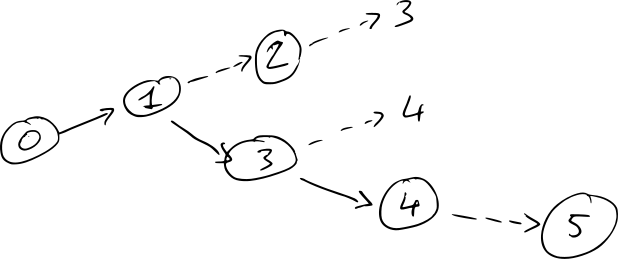
The following drawing illustrates a possible blocktree built by the Streamlet algorithm. The tree vertices represent blocks with their epoch number and payloads omitted (we can assume that payloads are all different). A vertex with a circle around it represents a notarized block, while a vertex without a circle is a block that has been voted for by at least one process but is not notarized. The longest finalized blockchain is represented with full arrows, while other arrows are dotted.
We can see that the block with epoch 2 is notarized, thus finalizing the block with epoch 1, but then the leader of epoch 3 did not notice that block 2 was notarized and instead extended the block with epoch 1 with a block with epoch 3. This cause a fork in the tree of notarized blocks, but not a fork in the finalized blockchain. Blocks with epoch number 3 and 4 in the finalized chain are final because of the notarized block with epoch 5.
Safety guarantee
The algorithm guarantees that if two chains are final, then one is a prefix of the other. This is the consistency property of the algorithm.
Note that the consistency guarantee holds even if processes proceed through epochs at different speeds and may not be in the same epoch at the same time.
Liveness guarantee
In an asynchronous network, Streamlet cannot guarantee that a block will ever get finalized. This is because the consensus problem is famously unsolvable in an asynchronous network. Instead, to guarantee liveness properties, we must make additional assumptions. To do so, first define a synchronous epoch as an epoch in which all non-faulty processes receive each other’s messages before the end of the epoch, and in which the leader is not faulty.
We can now state Streamlet’s liveness guarantee: The Streamlet algorithm guarantees that, after 4 consecutive synchronous epochs, a new blocks gets finalized.
Note that, according to the usual definitions of liveness and safety used in the academic field of distributed computing, this is a safety property because it can be violated in a bounded execution. But, as in the Streamlet paper, we’ll call it liveness anyway.
Note that the Streamlet paper proves that we need 5 synchronous epochs to guarantee finalizing one more block, but I believe this is overly conservative and that 4 epochs suffice.
Streamlet in PlusCal/TLA+
Blocks
Processes in the Streamlet algorithm can be seen as building a block tree out of which emerges a unique, finalized blockchain. Thus, we need to model blocks, block trees, and blockchains.
Except for the genesis block, a block consists of the hash of its parent block, an epoch, and a payload. Thus, assuming that there are no hash collisions, a block uniquely determines all its ancestors up to the genesis block, or, equivalently, a unique sequence of epoch-payload pairs. We could model a block as a recursive data structure containing its parent. However, to make things simpler, we model a block as a sequence of pairs, each containing an epoch and a payload. No information is lost in the process: in both cases, a block determines a unique sequence of epoch-payload pairs.
For example, this is a block in TLA+ notation:
<< <<1, tx1>>, <<3, tx3>>, <<4, tx4>> >>
This TLA+ block models a real block consisting of epoch 4, payload tx4, and the hash of a previous block with epoch 3, payload tx3, and a hash of a previous block with epoch 1, payload tx1, and the hash of the genesis block.
In this model of blocks, a block tree is a prefix-closed set of blocks, and a blockchain is a block tree without branching.
Moreover, we can extend a block b just by appending an epoch-payload tuple to it.
Finally, the genesis block is the empty sequence <<>>.
We now define the epoch of a block b as 0 if b is the genesis block and otherwise as the epoch found in the last tuple in b.
In TLA+, this translates to:
  Epoch(b) ==
      IF b = Genesis
      THEN 0
      ELSE b[Len(b)][1]
Moreover, the parent of a block b is the genesis block if b has length 1, and otherwise it’s the block obtained by removing the last element of b.
In TLA+:
Parent(b) == IF Len(b) = 1 THEN Genesis ELSE SubSeq(b, 1, Len(b)-1)
First specification
We start with a specification that makes use of non-determinism in order to eschew irrelevant details and capture the essence of how Streamlet ensures safety. The specification, appearing below and in Streamlet.tla, is very short. With generous formatting, it consists of a mere 44 lines of PlusCal.
CONSTANTS
        P \* The set of processes
    ,   Tx \* Transtaction sets (the payload in a block)
    ,   MaxEpoch
    ,   Quorum \* The set of quorums
    ,   Leader(_) \* Leader(e) is the leader of epoch e

1   --algorithm Streamlet {
2       variables
3           vote = [p \in P |-> {}], \* the vote cast by the processes,
4           proposal = [e \in E |-> <<>>];
5       define {
6           E == 1..MaxEpoch \* the set of epochs
7           Genesis == <<>>
8           Epoch(b) ==  \* the epoch of a block
9               IF b = Genesis
10              THEN 0 \* note how the root is by convention a block with epoch 0
11              ELSE b[Len(b)][1]
12          Parent(b) == IF Len(b) = 1 THEN Genesis ELSE SubSeq(b, 1, Len(b)-1) \* the parent of a block
13          Blocks == UNION {vote[p] : p \in P}
14          Notarized == {Genesis} \cup \* Genesis is considered notarized by default
15              { b \in Blocks : \E Q \in Quorum : \A p \in Q : b \in vote[p] }
16          Final(b) ==
17              /\  \E tx \in Tx : Append(b, <<Epoch(b)+1,tx>>) \in Notarized
18              /\  Epoch(Parent(b)) = Epoch(b)-1
19          Safety == \A b1,b2 \in {b \in Blocks : Final(b)} :
20              Len(b1) <= Len(b2) => b1 = SubSeq(b2, 1, Len(b1))
21      }
22      process (proc \in P)
23          variables
24              epoch = 1, \* the current epoch of p
25              height = 0; \* height of the longest notarized chain that p voted to extend
26      {
27  l1:     while (epoch \in E) {
28              \* if leader, make a proposal:
29              if (Leader(epoch) = self) {
30                  with (parent \in {b \in Notarized : height <= Len(b) /\ Epoch(b) <= epoch},
31                          tx \in Tx, b = Append(parent, <<epoch, tx>>))
32                      proposal[epoch] := b
33              };
34              \* next, either vote for the leader's proposal or skip:
35              either {
36                  when Len(proposal[epoch]) > height;
37                  vote[self] := @ \cup {proposal[epoch]};
38                  height := Len(proposal[epoch])-1
39              } or skip;
40              \* finally, go to the next epoch:
41              epoch := epoch + 1;
42          }
43      }
44  }
Let me now describe the specification informally.
We have two global variables, vote and proposal, and two process-local variables, epoch and height, with the following meaning:
- For every process
p,vote[p]is the set of all votes cast bypso far. - For every epoch
e,proposal[e]is the leader’s proposal for epocheunlessproposal[e]is empty (i.e. equal to the empty sequence<<>>). - For every process, the local variable
epochis the current epoch the process. - For every process, the local variable
heightis the height of the longest notarized block that the process ever voted to extend.
Lines 6 to 20, we make a few useful definitions, most notably:
- Line 14, a block is notarized when a quorum unanimously voted for it.
- Line 16, a block
bis final when:- line 17,
bhas a notarized child with epochEpoch(b)+1, and - line 18, the epoch of
b’s parent isEpoch(b)-1
- line 17,
- Finally, line 19, the algorithm is safe when every two final blocks are the same up to the length of the shortest.
Now consider a process we will call self at line 27, when self is just starting it current epoch epoch.
First, lines 29 to 33, if self is the leader of the current epoch, self picks a notarized block show length is greater than height, extends it with a new payload tx, and proposes it for the epoch.
This is an example of how we use non-determinism to abstract over irrelevant details:
In the original Streamlet algorithm, a process creates a proposal by extending one of the longest notarized chains it knows of.
Here we abstract over this rule by allowing the process to pick an arbitrary notarized block.
This is a sound abstraction because it does not restrict the behaviors of the algorithm (in fact, it may add new behaviors).
Next, line 35, self either votes for the leader’s proposal or skips voting in this epoch
- Line 36,
selfchecks that the proposal extends a block whose height is at least the height of last block thatselfvoted to extend. If so,selfvotes for the proposal (line 37) and updatesheightto reflect the fact that it just voted to extend a block of height equal to the length of the proposal minus one. - Alternatively, line 39,
selfskips voting in this epoch. This models the case in whichselfdid not receive the leader’s proposal, or the proposal is not at least of height equal to the height of the longest notarized block thatselfever voted to extend.
Finally, line 41, self goes to the next epoch.
Model-checking results
With TLC, I was able to exhaustively model-check that the Safety property holds for 3 processes, 2 payloads, and 6 epochs.
This was done on a 24 core Intel(R) Xeon(R) CPU E5-2620 v2 @ 2.10GHz with 40GB of memory allocated to TLC, and it took about 4 hours and 20 minutes.
I think this is an interesting configuration because we have multiple quorums (sets of 2 processes at least), branching even within a single epoch (because of the 2 payloads), and enough epochs to obtain finalized chains containing non-consecutive epoch numbers and having notarized but non-final branches. Thus, the model-checking results give me high confidence that the Streamlet algorithm is indeed safe.
Liveness and sequentialization
To model-check the liveness property of Streamlet, we must modify our specification and introduce synchronous epochs. Moreover, we’ll need to be able to exhaustively model-check the specification for more than 6 epochs to get meaningful results. This is because the liveness property states that a new block must be decided after 5 synchronous epochs. To truly test this claim, we need to check that it holds even after a few asynchronous epochs have had the chance to wreak as much havoc as possible. Just taking 3 asynchronous epoch gives use 3+5=8 epochs to check. Thus, we better find a way to speed up model-checking.
As we will next see, we can take advantage of the commutativity of some steps in the protocol to reduce the problem to checking only a restricted set of canonical executions. This is very effective and will allow us to exhaustively check that, even after 5 totally asynchronous epochs, Streamlet guarantees that a new block is finalized after 5 synchronous epochs. In fact, we’ll see that it only takes 4 synchronous epoch for a new block to be finalized. I believe that this is true in general, and that the bound of 5 proved in the Streamlet paper is overly conservative.
Sequentialization
Consider an execution e of Streamlet and two steps s1 and s2 of two different processes p1 and p2 such that s1 occurs right before s2, s1 is a step of epoch e1, s2 is a step of epoch e2, and e2<e1.
Note that the global state written by s2 is never read by s1 because a process in epoch e1 only uses information from epoch smaller or equal to e1.
Moreover, if step s2 can take place at some point in an execution, adding more steps of other processes epochs lower than e2 before s2 never prevents s2 from taking place (i.e. the protocol is monotonic).
The previous paragraph shows that we can reorder all steps in an execution e1 to obtain a new execution e2 in which all steps of epoch 1 happen first, then all steps of epoch 2, then all steps of epoch 3, etc.
Crucially, the end state of the system in e1 and e2 are the same.
Thus, if we prove that all executions like e2, which we call sequentialized executions, are safe and live, then we can conclude that all executions are safe and live.
This is because we express safety and liveness as state predicates, and, by our crucial observation above, restricting ourselves to sequentialized executions does not change the set of reachable states.
Moreover, with a slightly more complex justification, we can also reorder the steps of different processes within the same epoch as long as the leader always takes the first step. This means that we can schedule processes completely deterministically, as in a sequential program, without loosing any reachable states.
This is what we do in the specification SequentializedStreamlet.tla.
There, we specify a scheduler that schedules all processes deterministically.
The result is that the set of behaviors that the TLC model checker must explore is drastically reduced.
For example, it takes only about 15 minutes to exhaustively explore all executions with 3 processes, 2 payloads, and 6 epochs; in contrast, it took about 4 hours and 20 minutes with the previous specification.
Note that this style of reduction is well-known and was used by Dwork, Lynch, and Stockmeyer in 1984 in order to simplify reasoning about their algorithms. Several recent frameworks use this type of reduction to help engineers design and verify their algorithms. For example, PSync provides a programming language to develop consensus algorithms directly in a model somewhat similar to the sequential model we used, and an efficient runtime system to deploy such algorithms. We have taken a rather ad-hoc and informally justified approach to our sequentialization of Streamlet. In contrast, methods such as inductive sequentialization, supported by the Civl verifier, offer a principled approach to applying such reductions.
Expressing the liveness property
To check the liveness property, we must first have a way to specify that epochs become synchronous after a given, fixed epoch.
To this end, we introduce a constant GSE (for global synchronization epoch) and we add constraints that model the fact that all epoch including and after GSE are synchronous.
Remember that in a synchronous epoch, every node receives the leader’s proposal and every node receives all the votes of the other nodes. This is reflected as follows in the PlusCal/TLA+ specification:
- In epoch
GSEand after, nodes do not skip the epoch and vote for the leader’s proposal if the proposal is longer than the longest chain that the node has ever voted to extend. - In epoch
GSE, the leader makes a proposal, but the proposal doesn’t necessarily extend a longest notarized chain because, even though the leader must receive all previous votes by the end of epochGSE, it might not yet have by the time it makes its proposal. - In epoch
GSE+1and above, the leader proposes to extend one of the longest notarized chains.
Given the above, we now state the liveness property as:
Liveness == (epoch = GSE+4) => \E b \in Blocks : Final(b) /\ Epoch(b) >= GSE-1
In English, this states that by the beginning of epoch GSE+4, there is a final block whose epoch is greater or equal to GSE-1.
You might wonder where this constraint on the block’s epoch comes from.
The answer is that we want to show that a new block, i.e. a block which was not final in epoch GSE, is now final.
It is easy to see that, when GSE starts, no block with an epoch greater or equal to e-1 can be final when epoch e starts.
Thus, any final block with an epoch greater or equal to GSE-1 was not final when epoch GSE started and can be considered “new”.
The sequentialized specification with liveness
Omitting definitions that are the same as before, here is the sequentialized specification of Streamlet. You can also find it in SequentializedStreamlet.tla
1   --algorithm Streamlet {
2       variables
3           height = [p \in P |-> 0], \* height of the longest notarized p voted to extend
4           votes = [p \in P |-> {}], \* the votes cast by the processes
5           epoch = 1, \* the current epoch
6           scheduled = {}, \* the processes that have been scheduled already in the current epoch
7           proposal = <<>>; \* the proposal of the leader for the current epoch
8       define {
9           NextProc ==
10              IF scheduled = {}
11              THEN CHOOSE p \in P : Leader(epoch) = p
12              ELSE CHOOSE p \in P : \neg p \in scheduled
13          \* It takes at most 4 epochs to finalize a new block:
14          Liveness == (epoch = GSE+4) => \E b \in Blocks : Final(b) /\ Epoch(b) >= GSE-1
15      }
16      process (scheduler \in {"sched"})
17      {
18  l1:     while (epoch \in E) {
19              with (proc = NextProc) {
20                  \* if proc is leader, make a proposal:
21                  if (Leader(epoch) = proc)
22                      with (parent \in {b \in Notarized : height[proc] <= Len(b) /\ Epoch(b) <= epoch},
23                              tx \in Tx, b = Append(parent, <<epoch, tx>>)) {
24                          \* after the first synchronous epoch, the leader is able to pick a notarized block with the highest height:
25                          when epoch > GSE => \A b2 \in Notarized : Len(b2) <= Len(parent);
26                          proposal := b
27                      };
28                  \* next, if possible, vote for the leader's proposal:
29                  either if (height[proc] <= Len(proposal)-1) {
30                      votes[proc] := @ \cup {proposal};
31                      height[proc] := Len(proposal)-1
32                  }
33                  or {
34                      when epoch < GSE; \* Before GSE, we may miss the leader's proposal
35                      skip
36                  };
37                  \* go to the next epoch if all processes have been scheduled:
38                  if (scheduled \cup {proc} = P) {
39                      scheduled := {};
40                      epoch := epoch+1
41                  }
42                  else
43                      scheduled := scheduled \cup {proc}
44              }
45          }
46      }
47  }
Model-checking results
I was able to exhaustively check the liveness property with 3 crash-stop processes, 2 block payloads, and 9 epochs among which the first 5 are asynchronous while the remaining 4 are synchronous (i.e. “GST” happens before epoch 6).
As before, this was done on a 24 core Intel(R) Xeon(R) CPU E5-2620 v2 @ 2.10GHz with 40GB of memory reserved for TLC.
It took one hour and four minutes to complete and TLC found 320,821,303 distinct states for a depth of 29 steps.
I was also able to exhaustively check safety for 3 processes, 2 payloads, and 7 asynchronous epochs. This took 16 hours and TLC found 3,262,833,142 distinct states for a depth of 23 steps.
Related work
There is another excellent PlusCal/TLA+ specification of the crash-fault Streamlet algorithm described in Murat’s blog.
Compared to the present specification, this earlier specification uses a shared-whiteboard model of messages in which all processes receive a given message at the same time. This means that processes always have the same view of the system, which precludes some interesting behaviors of the Streamlet algorithm. In contrast, the specifications that I present reflect the fact that processes have different, partial views of what blocks have been notarized or not.
Shir Cohen and Dahlia Malkhi compare Streamlet and HotStuff in the following blog post. They note that Streamlet lacks some of the qualities of an engineering-ready protocol like HotStuff. While their blog post is very interesting, I do not agree with the claim that Streamlet requires synchronized epochs. The original Streamlet presentation indeed stipulates that processes proceeds through epochs in lock-steps (using synchronized real-time clocks). However, any synchronizer that guarantees that epochs become synchronous after GST (in the sense that we have used in the current post) should work too.
Other notes
The rule that the leader uses to pick a block to extend can be slightly improved. In the original Streamlet, the leader proposes a new block that extends one of the longest notarized chains that the leader knows of. However, it would make some executions finalize a new block faster if the leader would instead pick the notarized block with the highest epoch that it knows of.
-
this deviates slightly from the original formulation and makes the specification simpler without any downsides ↩